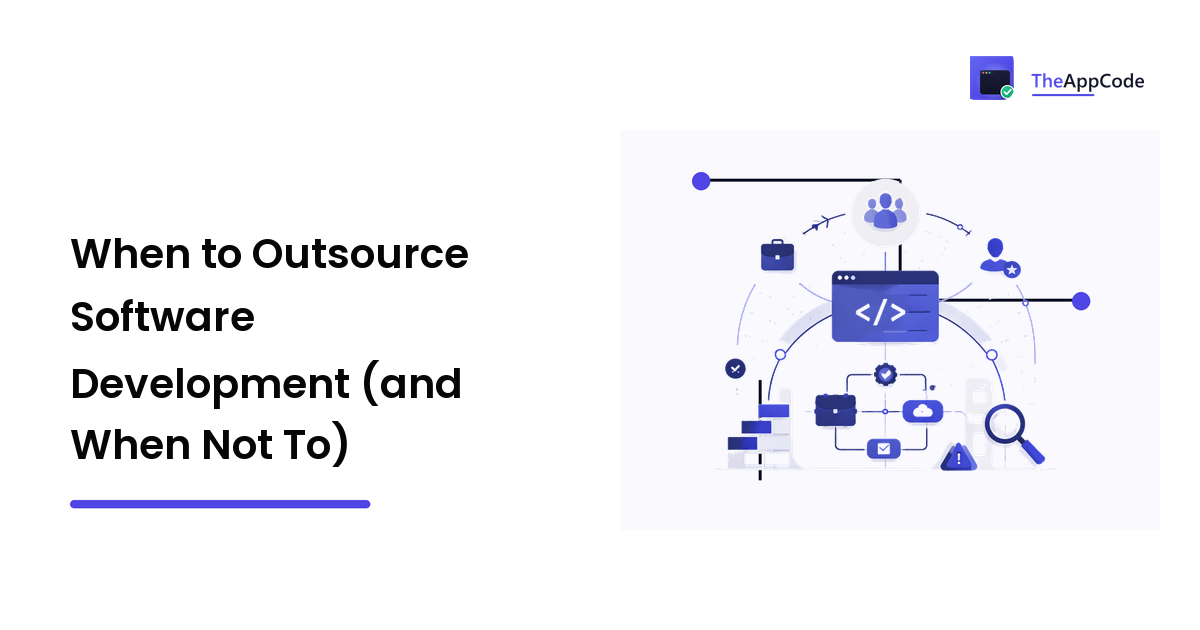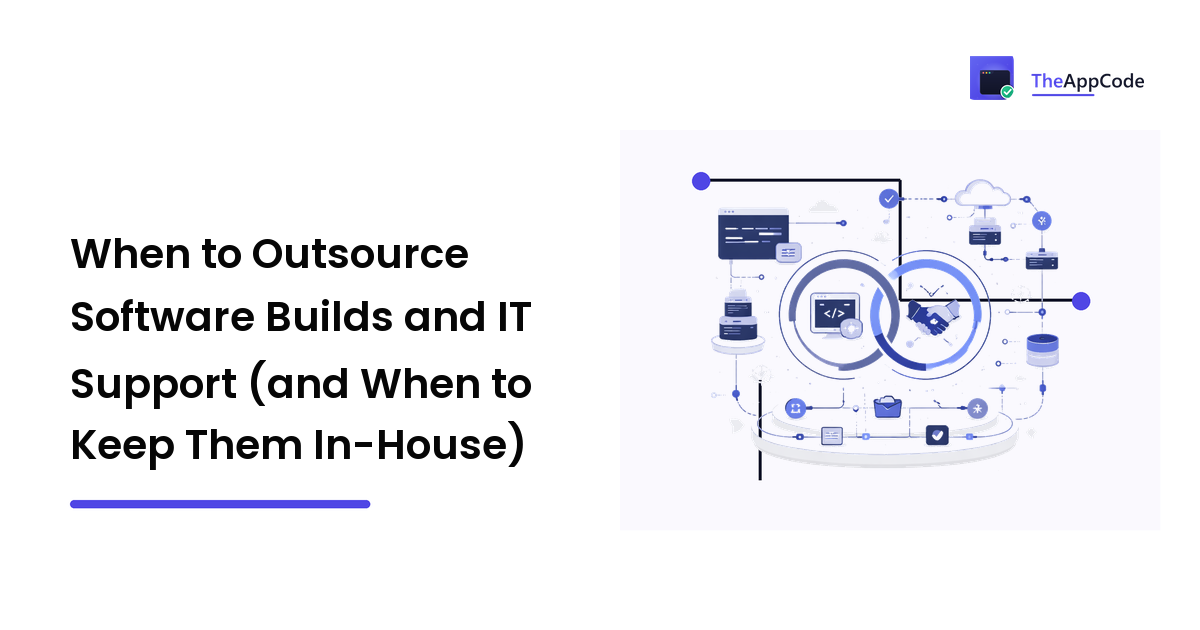
Every growing team hits the same wall: more work than people to do it. The reflex is to hire, but hiring is slow, permanent, and expensive, and not every task justifies a full-time seat. Outsourcing — contracting a build or an ongoing service to an outside team — is the other lever. Used well, it buys capacity and specialist skill without a headcount commitment. Used badly, it hands you a codebase nobody understands and a support contract you can't leave.
This guide is about making that call deliberately: which work is a good candidate to outsource, what to keep in-house, how to scope an engagement so you get maintainable output, and the quality gates that protect you from the classic failure modes. The short version: outsource work that is well-defined and peripheral to your core, keep the work that defines your product, and treat any outside code as if it will one day become your problem — because it will.
The real question: is this work core or context?
The most useful lens isn't cost — it's whether the work is core or context. Core work is the thing your product is actually good at: the domain logic, the data model, the parts that give you an edge and that you'll change for years. Context work is everything necessary but undifferentiated — the marketing site, the CI setup, a one-off data migration, tier-one IT support.
Core work belongs in-house — not because outsiders can't write it, but because the knowledge of why it's built the way it is has to live with the people who evolve it. Outsource core logic and you export the understanding that makes the next feature cheap to build. Context work is different: it's well-scoped, changes rarely, and losing the memory of exactly how the CI cache was tuned costs you little.
A quick test: if this system needs a deep change every quarter, keep it close; if it's "build it right once and mostly leave it alone," it's a candidate to contract out.
Good candidates to outsource
- Bounded, spec-able builds. A payment integration, a component library, a reporting dashboard on an existing API. The clearer the boundary, the better the outcome, because you can write an acceptance test for "done."
- Specialist skills you need rarely. A security audit, an accessibility pass, native mobile work when your team is web-first. Paying for a week of deep expertise beats hiring someone whose skill you'll use twice a year.
- Ongoing operational load. Tier-one IT support, monitoring rotations, routine maintenance and patching — real work, but rarely the best use of your senior engineers' attention.
- Overflow capacity under a deadline. When the roadmap is fixed and the constraint is hands, a contracted team can run a parallel, well-fenced workstream.
The same discipline applies to all of these: the more precisely you can describe the finished state, the more successfully you can hand it off. If you can't write the acceptance criteria, you're not ready to outsource it yet.
What to keep in-house
Keep the domain model, the architectural decisions, and the parts of the system under active, frequent change. Keep enough platform ownership — deployment, secrets, the production database — that you're never locked out of your own system. You can outsource building a service; you should not outsource knowing how your production works.
The build-vs-outsource decision rhymes with the build-vs-buy decision teams make when choosing a platform in the first place — the same trade-off of control versus maintenance versus speed. Our guide to choosing a build approach walks through that reasoning end to end.
How to scope an engagement so you get maintainable code
Most outsourcing disappointments trace back to a vague brief, not a bad vendor. Structure protects you:
- Write the acceptance criteria first. Define "done" as observable behavior — endpoints that return the right shapes, tests that go green. Ambiguity is where budgets and timelines die.
- Own the interfaces. You specify the API contracts, the data schema, and the coding standards; the vendor implements against your boundaries rather than inventing their own. That's what keeps the result integrable.
- Require tests and documentation as deliverables, not extras. Untested outsourced code is a liability the day the contract ends.
- Start small and time-boxed. A first engagement should be a contained piece of work with a clear checkpoint, not a six-month commitment. You're evaluating the working relationship as much as the code.
- Plan the handover from day one. Agree up front on how the work transfers — repository access, a walkthrough, a maintenance window — so knowledge moves to your team instead of leaving with theirs.
Finding a partner without gambling
The hard part is sourcing a team you can trust across regions and time zones. This is where a regional services portal earns its place: instead of cold-searching, you start from a directory oriented to a specific market. Nepal IT is one such portal for the Nepali technology market — useful precisely because a curated regional listing narrows a noisy field down to vendors operating under one set of local norms, which makes reference-checking and communication expectations more predictable than a global freelance marketplace.
Regional sourcing has a concrete engineering benefit beyond cost: time-zone overlap. A team a few hours offset from yours can do genuine same-day collaboration, which matters more for build quality than a headline rate does — a cheaper team you can only reach asynchronously often costs more in round-trips than a pricier one you can pair with in real time.
Quality gates that make outsourcing safe
Treat outsourced contributions exactly like any other pull request — no more trust, no less:
- Code review by your team on every change. Non-negotiable, and it doubles as knowledge transfer.
- CI enforces your standards. Linting, tests, and build checks run automatically so quality doesn't depend on goodwill.
- Least-privilege access. Scoped credentials, a separate environment where sensible, and no standing access to production secrets.
- A defined exit. Know before you start how you'd bring the work fully in-house. If the answer is "we couldn't," the dependency is too deep.
Put these in place and outsourcing becomes a capacity lever you can pull with confidence rather than a leap of faith.
FAQ
Isn't outsourced code always lower quality?
No — quality tracks the process, not the postcode. Outsourced work reviewed through your own CI and pull-request standards can match in-house work; unreviewed in-house work can be just as bad. What matters is enforcing the same gates on every change regardless of who wrote it.
Is outsourcing safe, or what's the catch?
The genuine risk is knowledge loss: you end up with a working system nobody on your team understands, plus dependence on a vendor to change it. That's a real failure mode, not a rare one. You manage it by keeping core logic in-house, requiring tests and documentation as deliverables, reviewing every change yourself, and agreeing a handover plan up front. Do those and the catch mostly disappears; skip them and it's as risky as the horror stories suggest.
What should I never outsource?
Your production ownership and your core domain knowledge. You can contract out the building of almost anything, but always retain control of your production environment, secrets, and data — and keep the frequently-changing parts of the system close, because that's where institutional understanding pays off.
Next step
Outsourcing is neither a shortcut nor a trap — it's a capacity decision you make one scoped piece of work at a time. Separate core from context, keep what defines your product, write real acceptance criteria for what you hand off, and gate every change through your own review and CI. If regional sourcing fits your build, evaluate a directory like Nepal IT by running one contained engagement through it and measuring the result before you commit to anything larger.