A single mobile profile screen needs three things: the user's name and avatar, their five most recent posts, and the comment count on each. With a typical REST API that's a small waterfall — fetch the user, fetch their posts, then fetch counts — or a bespoke endpoint someone added just for this screen. With GraphQL it's one request that returns exactly those fields and nothing else. That one example contains the entire REST-vs-GraphQL debate.
The takeaway up front: REST vs GraphQL is not old versus new — it's a trade between leaning on the web's built-in machinery and giving clients total control over the response. REST models data as resources over many URLs and inherits HTTP's caching, status codes, and ubiquitous tooling for free, at the cost of over- and under-fetching. GraphQL exposes one typed endpoint where the client asks for exactly the fields it wants in a single request — eliminating that waste, but handing you the caching, query-cost, and N+1 problems HTTP used to solve for you. The right choice follows from who consumes your API and how your data is shaped, not from which is newer.
REST and GraphQL, defined
REST is an architectural style: data is modeled as resources, each addressed by a URL (/users/42, /users/42/posts) and manipulated with HTTP methods (GET, POST, PATCH, DELETE). The server decides what each endpoint returns. Because everything travels over standard HTTP verbs and status codes, every browser, proxy, CDN, and client library already understands it. (For how to design one well, see our REST API design guide.)
GraphQL is a query language and runtime that sits behind a single endpoint, conventionally POST /graphql. It's built around a typed schema that declares every field a client can ask for. Instead of the server dictating the response, the client sends a query describing the exact shape it wants, and the server returns precisely that.
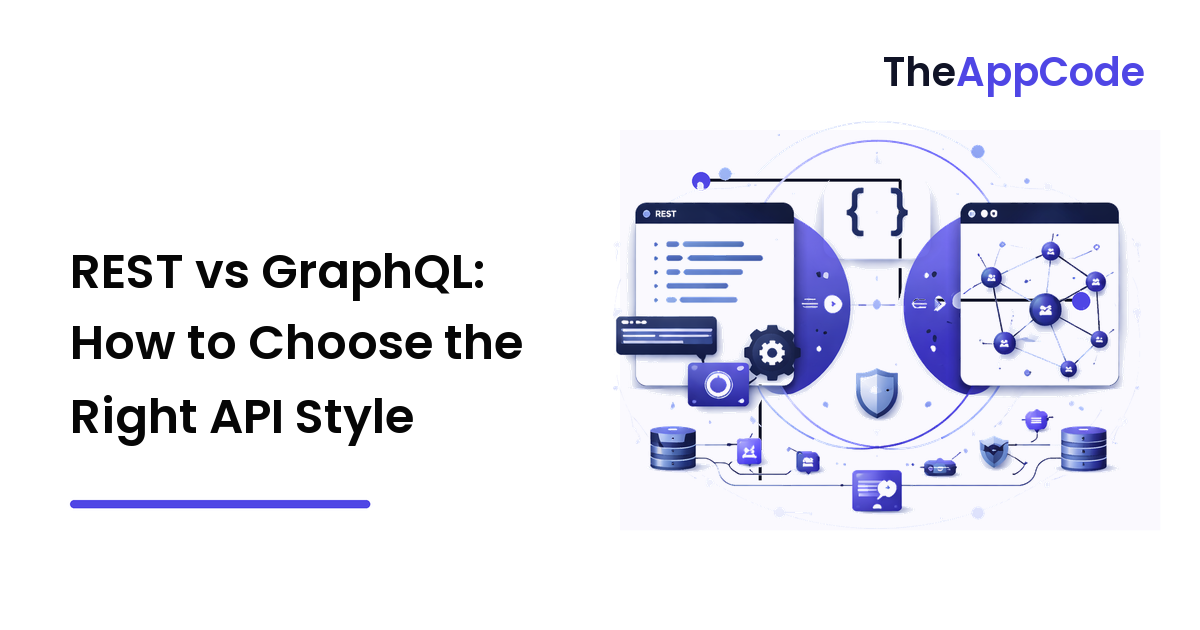
The one-line distinction: REST gives you many endpoints with server-defined responses; GraphQL gives you one endpoint with client-defined responses. Almost every trade-off below flows from that difference.
The core difference: who shapes the response
REST's fixed endpoints create two classic inefficiencies. Over-fetching is getting more than you need — GET /users/42 returns thirty fields when your list view wants two. Under-fetching is the opposite — one endpoint isn't enough, so you make several round trips to assemble a screen, the "waterfall" that hurts most on high-latency mobile networks.
Here's the profile screen as REST round trips:
GET /users/42                     # name, avatar (plus 28 fields you ignore)
GET /users/42/posts?limit=5       # the five latest posts
GET /posts/1001/comments?count=1  # ...and one count request per post
The same data as a single GraphQL query:
query {
  user(id: 42) {
    name
    avatarUrl
    posts(last: 5) {
      title
      commentCount
    }
  }
}
One request, exactly the fields the screen renders. This is GraphQL's headline benefit: the client, which knows what it needs, gets to say so.
Where REST still wins
Trading fixed endpoints away costs you things that are easy to undervalue until they're gone.
- HTTP caching for free. A
GETis cacheable by URL at every layer — browser, CDN, reverse proxy — viaCache-ControlandETag. For read-heavy and public APIs this is enormous: a well-cached endpoint serves most traffic without ever touching your application. GraphQL's singlePOSTendpoint sidesteps this machinery entirely. - Simplicity and ubiquity. Every language, framework, and tool speaks HTTP.
curl, browser devtools, log pipelines, and API gateways work with zero GraphQL-specific setup, so the learning curve is shallow and the operational surface small. - Honest status codes. REST uses HTTP status codes for their meaning —
404,401,429,500— so clients, monitoring, and load balancers interpret outcomes without parsing the body. - Bounded, predictable cost. Each endpoint does one known thing, so its database and CPU cost is knowable and per-route rate-limiting is straightforward.
If your API is largely CRUD, read-heavy, public, or consumed by third parties, these properties are exactly what you want — and why REST remains the default for most HTTP APIs.
Where GraphQL wins
GraphQL earns its complexity when clients are diverse and data is connected.
- No over- or under-fetching. Each client requests exactly its fields, so a slim mobile app and a rich web dashboard hit the same endpoint without either compromising.
- One request for nested, related data. Graph-shaped data — a user, their posts, each post's author and tags — comes back in a single traversal instead of a chain of calls.
- A strongly typed, self-documenting contract. The schema is enforced and introspectable, powering editor autocompletion, client code generation, and interactive explorers; mismatches surface at build time, not in production.
- Evolution without version bumps. You add fields freely — additive changes are non-breaking — and retire old ones with a
@deprecateddirective, avoiding the/v1→/v2cutover. - A natural aggregation layer. One GraphQL gateway can stitch several backend services or REST APIs into a single graph, a common backend-for-frontend pattern.
The GraphQL costs teams underestimate
GraphQL's flexibility isn't free; it relocates work rather than removing it.
- The N+1 resolver problem. A query over 50 posts that each resolve an author can fire 50 extra database queries unless you batch. The standard fix is a batching-and-caching layer (the DataLoader pattern), but you have to build and maintain it.
- Caching becomes your job. Losing HTTP caching means you take on normalized client caches, server-side response caching, and persisted queries — real infrastructure that REST got from the network for free.
- A larger security surface. A single flexible endpoint lets a client send a deeply nested or aliased query that's expensive to resolve. Production GraphQL needs query-depth limits, cost analysis, timeouts, and often persisted queries plus disabled introspection. Rate limiting is harder because one endpoint accepts requests of wildly different cost.
- Ambiguous error semantics. Many GraphQL servers return
200 OKwith a partial result and anerrorsarray, so "did it work?" can't be read from the status line alone — clients and dashboards need GraphQL-aware handling.
None of these are dealbreakers, but they are why GraphQL isn't automatically the "better" choice: it asks for engineering maturity in return.
REST vs GraphQL at a glance
| Dimension | REST | GraphQL |
|---|---|---|
| Endpoints | Many (one per resource) | One (/graphql) |
| Response shape | Server-defined | Client-defined |
| Over-/under-fetching | Common | Eliminated by design |
| Round trips for nested data | Several | One |
| HTTP caching (CDN/browser) | Built in via GET |
Not out of the box; app-level |
| Schema / typing | Optional (OpenAPI) | Mandatory, introspectable |
| Error signaling | HTTP status codes | Usually 200 + errors array |
| Versioning | Explicit (/v1) |
Schema evolution + @deprecated |
| Main server-side risk | Endpoint sprawl | N+1 resolvers, query cost |
| Rate limiting | Per endpoint, simple | Per query cost, harder |
Read the table as a mirror: nearly every GraphQL advantage is a REST cost, and vice versa — which is why "which is better" has no context-free answer.
How to choose: a decision framework
Ask these in order and let the answers point the way.
- Who consumes the API? One first-party client with predictable needs leans REST. Many diverse consumers — mobile, web, third parties — each wanting different fields lean GraphQL.
- How is your data shaped? Flat, mostly independent resources fit REST cleanly. Deeply connected, graph-like data that clients traverse in different ways fits GraphQL.
- How much do you rely on HTTP caching and CDNs? If cheap edge caching of read-heavy traffic is core to your performance or cost, REST hands it to you. If you can invest in application-level caching, GraphQL is viable.
- Is it public or third-party facing? Public and partner APIs favor REST's ubiquity, predictability, and simple mental model. Internal APIs serving your own varied frontends are where GraphQL's flexibility pays off soonest.
- What operational maturity can you fund? REST is cheaper to run safely. GraphQL demands discipline — N+1 batching, query-cost limits, caching — so budget for it before adopting.
A useful default: start with REST, and reach for GraphQL when endpoint sprawl or client-specific data needs become a recurring tax.
You don't have to choose only one
REST vs GraphQL isn't exclusive. A common, pragmatic setup is a GraphQL gateway in front of REST services: teams keep simple, independently cacheable REST endpoints, while one GraphQL layer composes them into the flexible graph frontends consume. Others keep REST public for its reach and use GraphQL internally. For high-throughput service-to-service calls, many teams reach past both for gRPC. The styles are tools, not tribes — mix them where each earns its place.
FAQ
Is GraphQL replacing REST?
No. GraphQL has grown fast for client-facing APIs with diverse, connected data, but REST remains the default for public, cache-heavy, and CRUD-style APIs because of its simplicity and free HTTP caching. They coexist, and plenty of systems use both.
Is GraphQL faster than REST?
It depends what you measure. GraphQL usually cuts network round trips and payload size by fetching exactly what a client needs in one request, which helps on high-latency connections. But it can be slower on the server without resolver batching (the N+1 problem) and caching, which REST gets from HTTP for free — faster on the wire, potentially costlier on the backend.
Why is caching harder in GraphQL?
REST caches responses by URL with standard HTTP headers, so CDNs and browsers cache GETs automatically. GraphQL usually sends every query as a POST to one endpoint, so URL-based caching doesn't apply. You replace it with normalized client caches, server response caching, and persisted queries — all of which you build and operate yourself.
When should I use GraphQL over REST?
Choose GraphQL when many clients need different, deeply related slices of the same data, when you're tired of adding an endpoint per screen, or when one layer must aggregate several backends. Choose REST for public or third-party APIs, simple CRUD, and read-heavy workloads where HTTP caching matters.
Can I use REST and GraphQL together?
Yes, and many teams do. A common pattern is a GraphQL gateway that composes underlying REST services — frontends get flexibility while backends stay simple and cacheable. Match each style to the consumer it serves best.
Next step
Look at the API work that filled your last month. If you keep adding endpoints for specific screens, or watching clients chain three calls to render one view, GraphQL's client-shaped queries would remove that tax. If your traffic is read-heavy, public, or leaning hard on CDN caching, REST's HTTP-native simplicity is already earning its keep. Decide by your consumers and your data, not by the trend, and you'll pick right. More vendor-neutral API and backend guides are at TheAppCode.